Solar panels for warehouses in Grays
The economics of a Grays rooftop array turn on how much of the generation the occupier uses on site. Each survey records the cladding profile, the usable area once rooflights and plant are removed, and the export limit worth applying for.
927 kWh per kWp a year at this latitude, so a 500 kWp array models at about 464,000 kWh. Source: EU PVGIS v5.2, SARAH3, 10 degree pitch, 14 percent system loss.
Book a roof survey in GraysIllustrative layout for a unit of this size. Your own figures come from the roof survey.
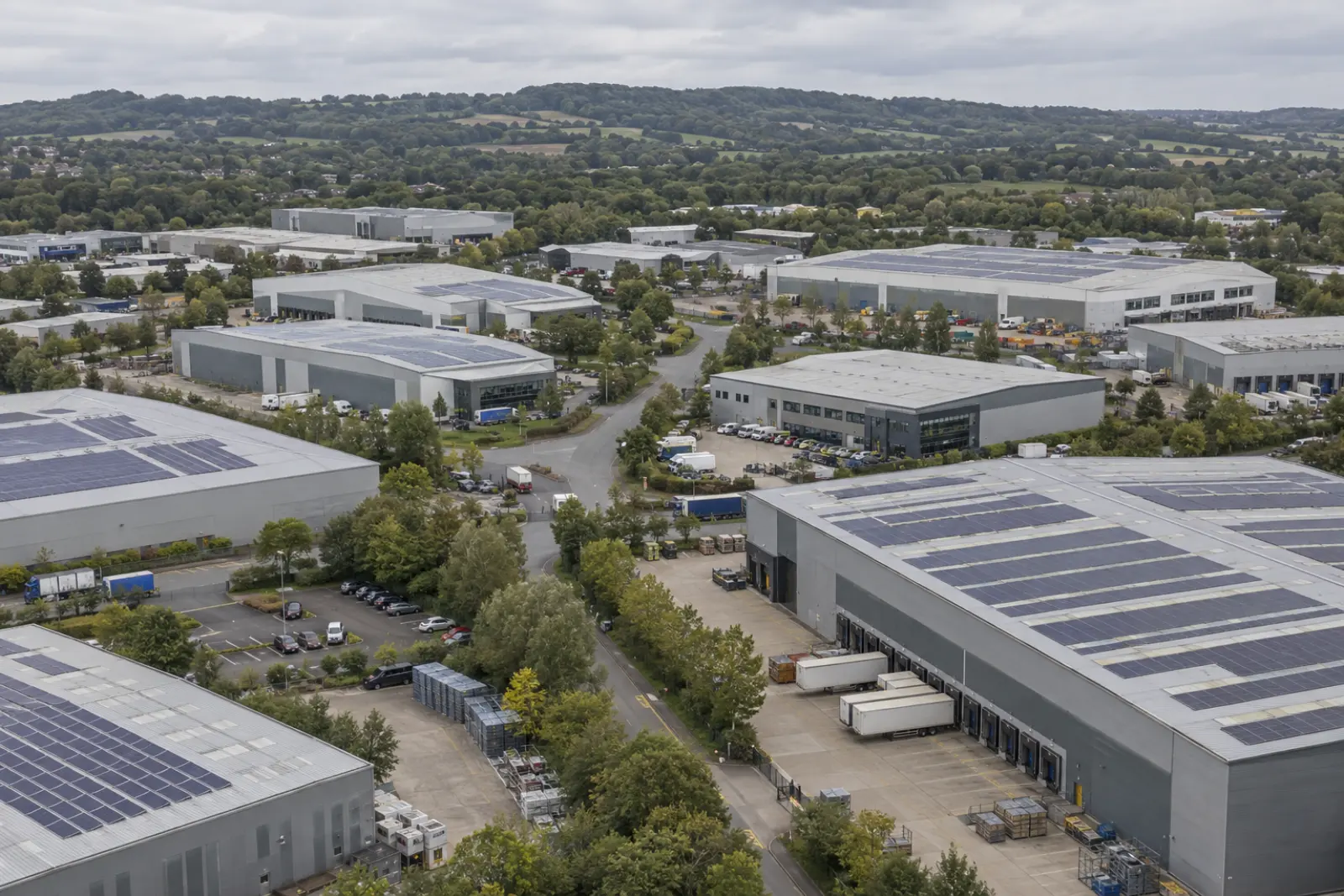
Warehouse rooftop solar across Essex
What a roof in Grays actually generates
Modelled irradiation at this latitude is 1190 kWh per square metre a year in the plane of a shallow-pitched roof, which works out at 927 kWh for every kWp installed (EU PVGIS v5.2, SARAH3, 10 degree pitch, 14 percent system loss). That is around 5 percent above the mean across the towns we cover, which is as good as UK rooftop gets outside the south coast.
Most of the units we look at here sit in the RM postcode area.
Thurrock is the planning authority for most sites here, and the built-up area holds a population of about 44,345, so the stock here runs to trade counters, light industrial terraces and the occasional larger shed (ONS Census 2021 built-up areas).
Grays ranks 8 of 10 towns we cover in Essex on modelled yield, against a national mean of 886 kWh per kWp. The county runs from 908 to 973, a spread of 65 kWh per kWp. On a 500 kWp array that is about 32,500 kWh a year between the strongest and weakest town in the county.
Solar already consented near RM17
From the government's Renewable Energy Planning Database, Q1 2026. These are the schemes on record in this postcode district, which is a fair guide to how the local network has been treating export applications.
| Scheme | Operator | Capacity | Mounting | Status |
|---|---|---|---|---|
| Morrisons - Solar Photovoltaic Panels | WM Morrisons Supermarkets Plc | 0.43 MW | Roof | Awaiting Construction |
Grid connection through UK Power Networks
UK Power Networks is the network operator here, and their answer on export capacity shapes the design. Any commercial array above 3.68 kW per phase connects under G99 rather than G98, and the application fixes what you are allowed to push back onto the network. If the local network is tight, limiting export rarely breaks the case here: most of the generation is consumed on site while the building is working.
Across Essex the planning database records 221 solar schemes totalling 2787 MW, of which 46 are operational (REPD Q1 2026).
Send us the postcode
Tell us where the unit is and roughly how big the roof is. We come back with what it can carry, what it would generate against your consumption, and the three ways to pay for it.
Lenzie Consulting Ltd arranges the survey and passes your details to our MCS-certified installation partner so they can quote.
Questions about solar in Grays
- What would a 500 kWp array produce in Grays?
- Yes, and the number matters more than the sunshine. At 927 kWh per kWp a year, a 500 kWp array on a Grays roof models at around 464,000 kWh. What changes the answer is how much of that you use on site rather than export. Source: EU PVGIS v5.2, SARAH3, 10 degree pitch, 14 percent system loss.
- Which network operator handles the connection in Grays?
- Applications go to UK Power Networks, who run the network across Essex. They decide the export limit, and we handle the G99 paperwork alongside the array design.
- What does Thurrock require for rooftop solar?
- Roof-mounted panels on a commercial building usually fall under permitted development, subject to the limits on projection above the roof plane and to the building not being listed or in a conservation area. We confirm the position with Thurrock before the design is finalised.