Solar panels for warehouses in Barrow-in-Furness
The economics of a Barrow-in-Furness rooftop array turn on how much of the generation the occupier uses on site. Each survey records the cladding profile, the usable area once rooflights and plant are removed, and the export limit worth applying for.
893 kWh per kWp a year at this latitude, so a 500 kWp array models at about 447,000 kWh. Source: EU PVGIS v5.2, SARAH3, 10 degree pitch, 14 percent system loss.
Book a roof survey in Barrow-in-FurnessIllustrative layout for a unit of this size. Your own figures come from the roof survey.
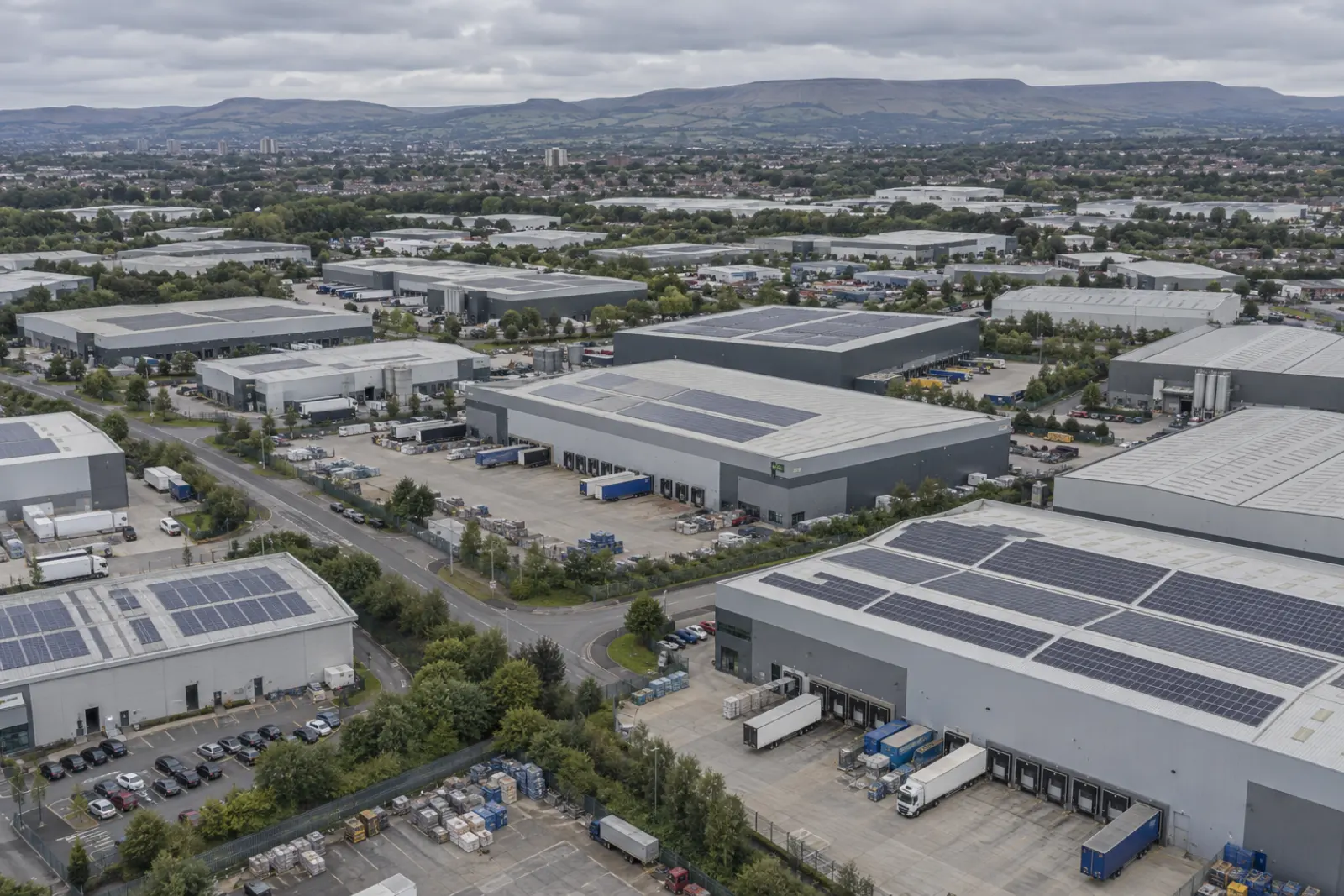
Warehouse rooftop solar across Cumbria
What a roof in Barrow-in-Furness actually generates
Modelled irradiation at this latitude is 1134 kWh per square metre a year in the plane of a shallow-pitched roof, which works out at 893 kWh for every kWp installed (EU PVGIS v5.2, SARAH3, 10 degree pitch, 14 percent system loss). That sits within a few percent of the mean across the towns we cover, so the case rests on your consumption pattern rather than on the weather.
Distribution stock around Barrow-in-Furness clusters on A590 and A595, which is where the large single-let roofs are.
Most of the units we look at here sit in the LA postcode area.
Barrow-in-Furness is the planning authority for most sites here, and the built-up area holds a population of about 55,255, so the stock here runs to trade counters, light industrial terraces and the occasional larger shed (ONS Census 2021 built-up areas).
Barrow-in-Furness ranks 1 of 6 towns we cover in Cumbria on modelled yield, against a national mean of 886 kWh per kWp. The county runs from 793 to 893, a spread of 100 kWh per kWp. On a 500 kWp array that is about 50,000 kWh a year between the strongest and weakest town in the county.
Solar already consented near LA14
From the government's Renewable Energy Planning Database, Q1 2026. These are the schemes on record in this postcode district, which is a fair guide to how the local network has been treating export applications.
| Scheme | Operator | Capacity | Mounting | Status |
|---|---|---|---|---|
| Sowerby Lodge Farm | Gamma Solar Limited | 5 MW | Ground | Operational |
| Sowerby Lodge | Sowerby Solar Solar Ltd | 4.2 MW | Ground | Planning Permission Expired |
| North Road - Roof Mounted Solar Arrays | Barrow Borough Council | n/a | Roof | Awaiting Construction |
| Sandscale Park - Solar Array | Cumbria County Council | 2 MW | Ground | Awaiting Construction |
| Dova Way, Barrow Island - Solar Array | Cumbria County Council | 2 MW | Ground | Awaiting Construction |
| JJC Waste Management, Sandscale Park - Solar Panels | JJC Waste Management | 0.73 MW | Roof | Awaiting Construction |
Grid connection through Electricity North West
Electricity North West operates the distribution network across Cumbria, so the export application goes to them. Anything larger than 3.68 kW per phase falls under G99, which means an application before commissioning rather than a notification afterwards. A constrained network is not the end of a scheme. Capping export costs little when the building already absorbs most of what the roof produces.
Across Cumbria the planning database records 86 solar schemes totalling 574 MW, of which 17 are operational (REPD Q1 2026).
Send us the postcode
Tell us where the unit is and roughly how big the roof is. We come back with what it can carry, what it would generate against your consumption, and the three ways to pay for it.
Lenzie Consulting Ltd arranges the survey and passes your details to our MCS-certified installation partner so they can quote.
Questions about solar in Barrow-in-Furness
- Is there enough sun in Barrow-in-Furness to make this work?
- Modelled at 893 kWh per kWp a year for a shallow-pitched roof at this latitude, which puts a 500 kWp array at roughly 447,000 kWh a year before shading. That array needs about 1,485 sqm of clear roof once walkways and setbacks are allowed for. Source: EU PVGIS v5.2, SARAH3, 10 degree pitch, 14 percent system loss.
- Who do we apply to for export in Barrow-in-Furness?
- Capacity varies street by street, and only Electricity North West can answer it for your connection. We ask the question early, because an export-limited offer changes the design rather than killing the scheme.
- Do we need planning permission in Barrow-in-Furness?
- In most cases no, because roof-mounted panels on commercial buildings sit within permitted development. The exceptions are listed buildings, conservation areas and arrays that stand proud of the roof plane. We check with Barrow-in-Furness first either way.
- Has anyone near LA14 already done this?
- The planning database records 6 solar schemes in this postcode district, 2 of them roof mounted. That matters less as proof that it works and more as evidence of how the local network has been treating export applications. Source: Renewable Energy Planning Database, Q1 2026.